Your child comes home from their first term of secondary school full of new words — ¡hola!, me llamo, tengo doce años — and part of you thinks: lovely… but I can’t help, I don’t speak a word of Spanish. Sound familiar? Here’s the good news: you don’t need to. You can give your Year 7 a brilliant start in Spanish with zero Spanish of your own.
Why Year 7 Spanish matters more than you’d think
Year 7 is where the whole language journey begins — and the habits, confidence and foundations built now carry all the way to GCSE. A confident start makes everything that follows easier; a shaky one is much harder to repair at 15.
Here’s the part most parents don’t realise: the children who wobble in that first year often decide “I’m just not good at languages” — and quietly give up. It’s almost never true. They didn’t lack ability; they just missed a few early foundations and lost confidence. Keep them steady now, and you head that off completely.
You’re not aiming for fluent by Christmas. You’re aiming for a child who feels capable and unafraid — because that’s the thing that lasts all the way to GCSE.
“But I don’t speak a word of Spanish!”
You genuinely don’t have to. Your job isn’t to teach Spanish — it’s to keep them practising, cheer them on, and take the fear out of getting things wrong.
In fact, one of the most powerful things you can do is let them teach you. “Go on — how do you say it?” Explaining a word to someone else is one of the best ways to lock it in, and your genuine interest is worth far more than any grammar you could offer. Your enthusiasm matters more than your Spanish.
What Year 7 Spanish actually covers
Most Year 7 courses work through the same core, everyday topics — the building blocks of the language. Knowing them helps you spot what your child is working on and encourage them:
- Introducing yourself — name, age, where you’re from, personality
- Free time & hobbies — what you like and don’t like doing
- School life — subjects, the timetable, opinions
- Family & friends — describing the people around you
- Where you live — your town, your home, your area
- Food & drink — meals, ordering, likes and dislikes
6 simple ways to help at home (no Spanish needed)
- Ask them to teach you. “How do you say ‘dog’ in Spanish?” Explaining it makes it stick — and makes them feel clever.
- Little and often. Ten minutes most days beats an hour once a week. Short and regular is how languages settle in.
- Label the house. Sticky notes on la puerta, la ventana, la mesa. Free, fun, and it works while nobody’s trying.
- Watch and listen in Spanish. A favourite show with Spanish audio or subtitles trains their ear painlessly.
- Praise the attempt, not the accent. Never correct pronunciation in a way that embarrasses them — confidence is the whole game.
- Make it real. Order in a tapas bar, greet a Spanish speaker, plan a holiday. Real reasons to use it beat any worksheet.
Your Year 7 Spanish Parent Guide
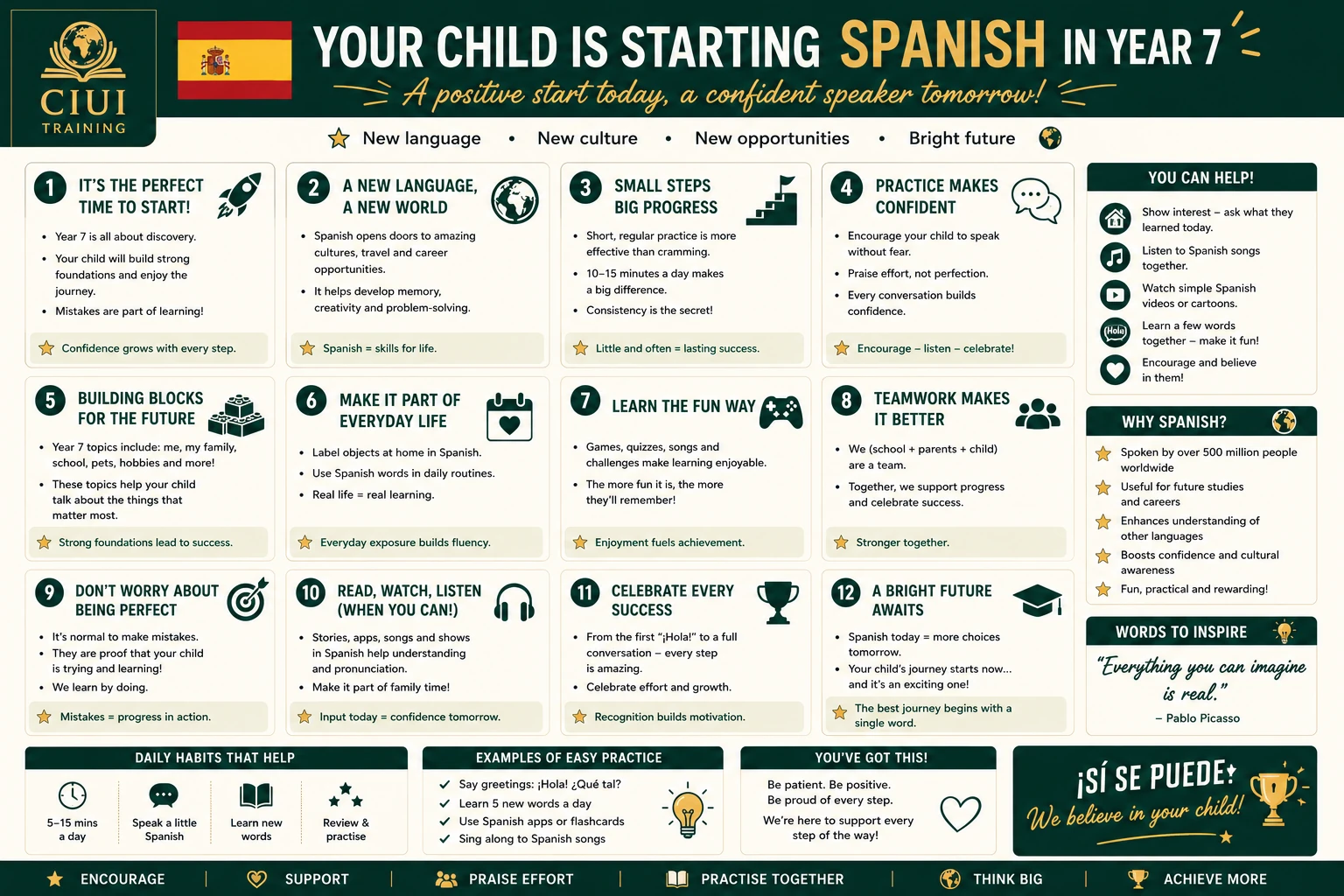
Love these tips? Here they all are on one bright, printable page — the daily habits, the easy practice ideas and the encouragement to keep them going. Free to download, yours to keep. Pop it on the fridge! 🧲
The one habit that makes the biggest difference
Speaking out loud. Languages live in the mouth, not on the page. Encourage your child to say the words — even quietly, even “wrong.”
A child who is happy to speak badly in Year 7 becomes a confident speaker by GCSE. A child who only ever reads and writes freezes the moment they have to actually talk — and speaking is worth a huge chunk of the GCSE. Getting comfortable saying things aloud now is the single best investment you can make.
Common Year 7 wobbles (and how to smooth them)
- Vocabulary overload. Too many words at once feels impossible. Focus on a handful, revisit them often — little and often again.
- “Everyone else is better than me.” They’re almost certainly not — and comparison quietly kills confidence. Measure them against last week, not the class.
- Fear of pronunciation. Reassure them: Spanish is spelled almost exactly how it sounds, so it’s far kinder than English or French.
- Falling behind after a missed week. Illness or a busy week happens. Catch up gently — a couple of short sessions — rather than panicking.
How our Year 7 Spanish course helps
This is exactly why we built the Spanish KS3 Year 7 course — to give your child (and you) a calm, confident, genuinely fun way to stay on top of Year 7 Spanish, with no tutor and no Spanish needed from you.
Each module is a set of interactive lessons your child works through at their own pace: tap-to-hear native audio on every single word, games that make vocabulary actually stick, and speaking practice built right in. The six modules cover the whole Year 7 year — you can start with Module 1 and build from there.
- £29★ Start here · Module 1Me presentoIntroducing yourselfStart the course →
- £29Module 2¡Qué divertido!Free time & hobbiesView module →
- £29Module 3Mi instiSchool lifeView module →
- £29Module 4Mi genteFamily & friendsView module →
- £29Module 5¿Dónde vives?Your town & homeView module →
- £29Module 6¡Comida!Food & drinkView module →
Give your Year 7 a confident start in Spanish
Interactive, self-paced, and made to be fun — with native audio on every word and speaking built in. No tutor, and no Spanish needed from you. Start with Module 1 and grow from there.
You don’t need to speak a word of Spanish to raise a confident Spanish speaker. Keep it fun, keep it regular, cheer every attempt — and let Year 7 be the year it all clicks. ¡Vamos!